Can Turnitin Detect Claude? What the AI Report Actually Sees
Turnitin lists Claude among the models its AI detector covers. Here is how it catches Claude text, where it misses, and how Claude's new watermark fits in.
For a while, Claude had a reputation on student forums as the "safe" chatbot. Its prose sounded less like ChatGPT, so the theory went, and detectors trained on GPT output would wave it through. Midterm season is a bad time to test that theory, and the evidence from 2026 says it no longer holds.
The short answer: yes, Turnitin can detect Claude, and the company says so explicitly. The longer answer involves how the detector works, where it still misses, and a new wrinkle that arrived in August: Anthropic now watermarks Claude's text.
Turnitin names Claude in its documentation
Turnitin keeps a list of the language models its English AI writing detector is trained to recognize. The AI writing detection FAQ, last updated October 14, 2026, lists Anthropic Claude alongside OpenAI's GPT models, Google Gemini, Meta Llama, DeepSeek, Grok and Mistral. Named Claude versions include Claude 3 Haiku, Claude Sonnet 4.6 and Claude Opus 4.6.
That list matters because Turnitin's detector is a classifier. It learns what text from specific model families looks like by training on large samples of it. A model that is missing from the training data is the one most likely to slip through, and Claude is not missing.
The same FAQ restates the rules that shape every report:
300-word minimum. Submissions need at least 300 words of long-form prose before the AI score is calculated.
The asterisk zone. Scores between 1% and 19% show only as an asterisk, with no percentage and no highlights.
A stated false-positive target. Turnitin says it aims to keep false positives under 1% for documents with more than 20% AI writing, measured against hundreds of thousands of papers written before ChatGPT existed.
Why Claude's writing still gets flagged
Claude does read differently from ChatGPT to a human. It hedges less in some places, structures arguments with more connective tissue, and has its own favorite phrases. To a classifier, those differences are smaller than they look.
AI detectors measure statistical properties of text. Two of the most cited are perplexity (how predictable each word is given the words before it) and burstiness (how much sentence length and structure vary across a passage). Large language models, Claude included, generate text by choosing likely next words, which produces low perplexity. They also tend toward even, well-formed sentences, which produces low burstiness. Turnitin's full method is proprietary, but the general mechanics are covered in how Turnitin's AI detection works.
Third-party testing points the same way. In a small July 2026 test, GPTZero generated 30 samples with Claude across Opus 4.8, Sonnet 4.6 and Haiku 4.5, including samples prompted to imitate a specific writer's style. Its detector flagged all 30 as AI. Thirty samples is not a large study, and GPTZero is grading its own product, but the result matches the pattern: style prompts change the vocabulary, while the underlying statistics stay recognizably machine-made.
Prompting Claude to "write like a college sophomore" or "add some mistakes" runs into the same wall. The output gets a different costume, and the rhythm underneath stays even.
Claude's watermark is a separate system
On August 14, 2026, Anthropic announced text watermarking for Claude. This is easy to confuse with Turnitin's detection, and the two work in completely different ways.
How it works. When Claude picks each word, it normally samples from a set of likely candidates at random. The watermark replaces that randomness with a key-driven pattern, based on Google DeepMind's SynthID-Text method. Anthropic says there are no hidden characters and nothing added to the text. The signal lives in the word choices themselves, so it survives copy and paste into Google Docs or Word.
Which models. The watermark applies to Claude models launched from August 2, 2026 onward, with older models getting it over the following months, according to Anthropic. The rollout is tied to EU AI Act transparency rules but applies worldwide.
What breaks it. Anthropic's own description is that light editing probably won't remove the watermark completely, while a complete rewrite where every word is replaced will. Detection is also weaker on short passages and on factual or lightly proofread text.
Who can check it. Only the key holder can verify the pattern. As of Anthropic's September 1 update, the detection API is in private preview for eligible organizations, a group that includes educational organizations, regulators and researchers. There is no public watermark checker.
What it cannot say. Anthropic states the watermark cannot distinguish "Claude wrote this" from "Claude heavily edited this," and it says nothing about human-written text.
Turnitin's AI score does not come from this watermark. It comes from Turnitin's own classifier, which is why Turnitin could flag Claude text long before any watermark existed. A paper written with an older, unwatermarked Claude model can still score high in Turnitin. A watermarked paper could, in principle, be identified by a party with API access even if a classifier missed it. Two separate checks, with separate blind spots.
Where detection of Claude falls short
Turnitin catching Claude text is not the same as catching it every time. The gaps are the same ones that apply to every model on its list.
Mixed documents. A paper that is partly Claude and partly the student's own writing produces a partial score. If the AI share lands below 20%, the report shows only an asterisk.
Heavy human revision. Restructuring arguments, rewriting for voice and adding specific examples changes the statistical shape the classifier reads. Substantially revised text scores closer to human writing.
Humanizer output, depending on the tool. Since August 2025, Turnitin has trained a separate model on the output of popular humanizer tools. Simple synonym swapping is what that model was built to catch. The details are in does Turnitin detect AI humanizers.
Short work. Anything under 300 words is not scored, and the watermark is weak on short passages too.
False positives. The flip side matters as much. Even a sub-1% false-positive rate means some fully human essays get flagged, and dense, formal academic writing is the style most likely to resemble model output. The em-dash myth post covers which "tells" are real and which are folklore.
What this means for students using Claude
The practical picture for anyone drafting with Claude this semester:
Unedited Claude output is the highest-risk version. It is exactly what Turnitin trained on, and newer Claude models may also carry a watermark.
Style prompts don't change much. Asking Claude to sound casual or human changes word choice, while perplexity and burstiness stay in the AI range.
Rewriting for rhythm does. Varying sentence length, cutting predictable transitions and reorganizing points changes the features detectors measure. The Duey Humanizer rewrites cadence and vocabulary distribution rather than swapping synonyms. No humanizer can promise a specific Turnitin score, so the output still needs a read-through and edits in the writer's own voice.
Check before submitting. Running the final draft through the Duey AI Detector shows how a classifier scores it and which passages stand out. It does not replicate Turnitin's proprietary model, but it reads the same kinds of signals.
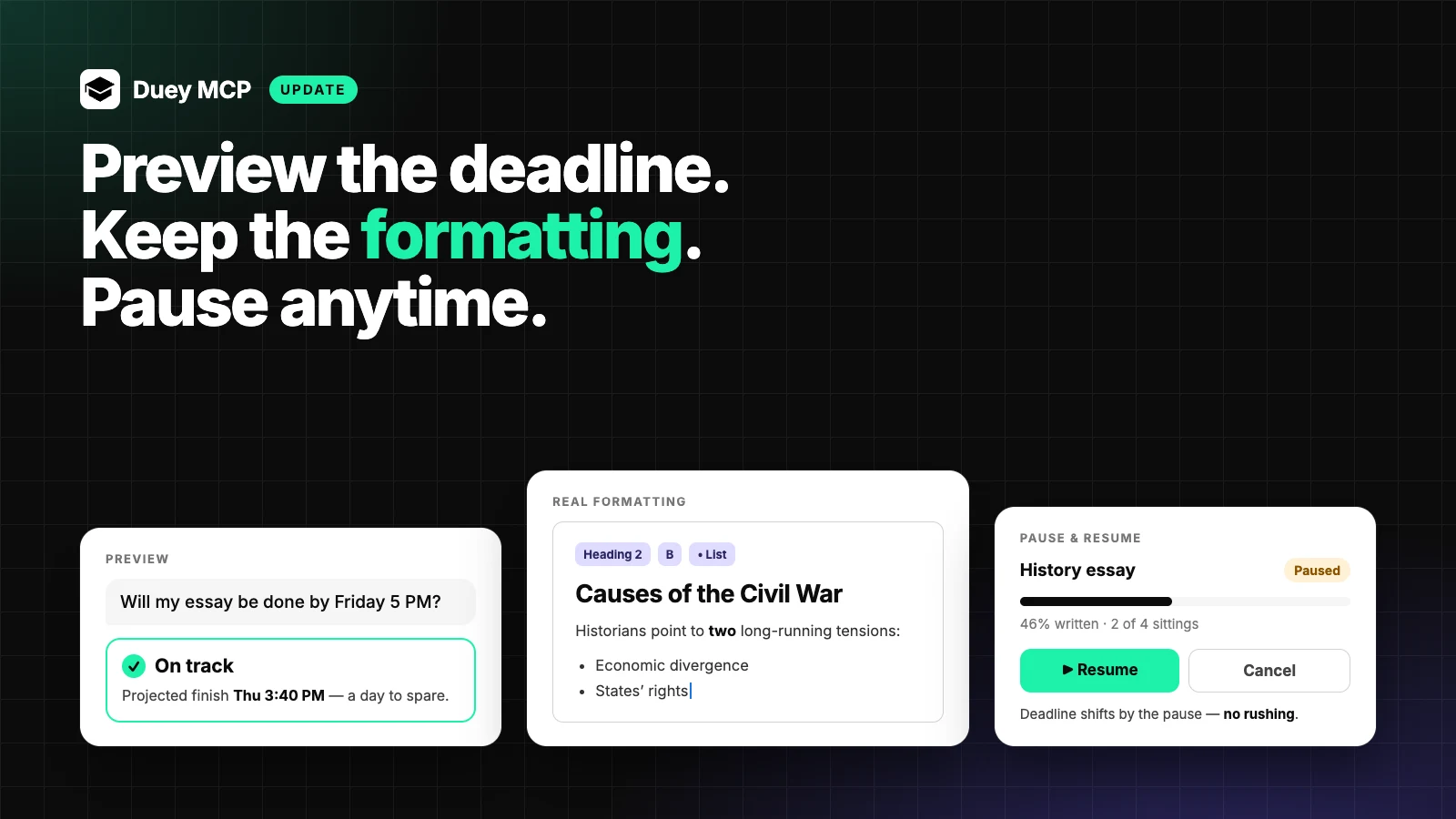
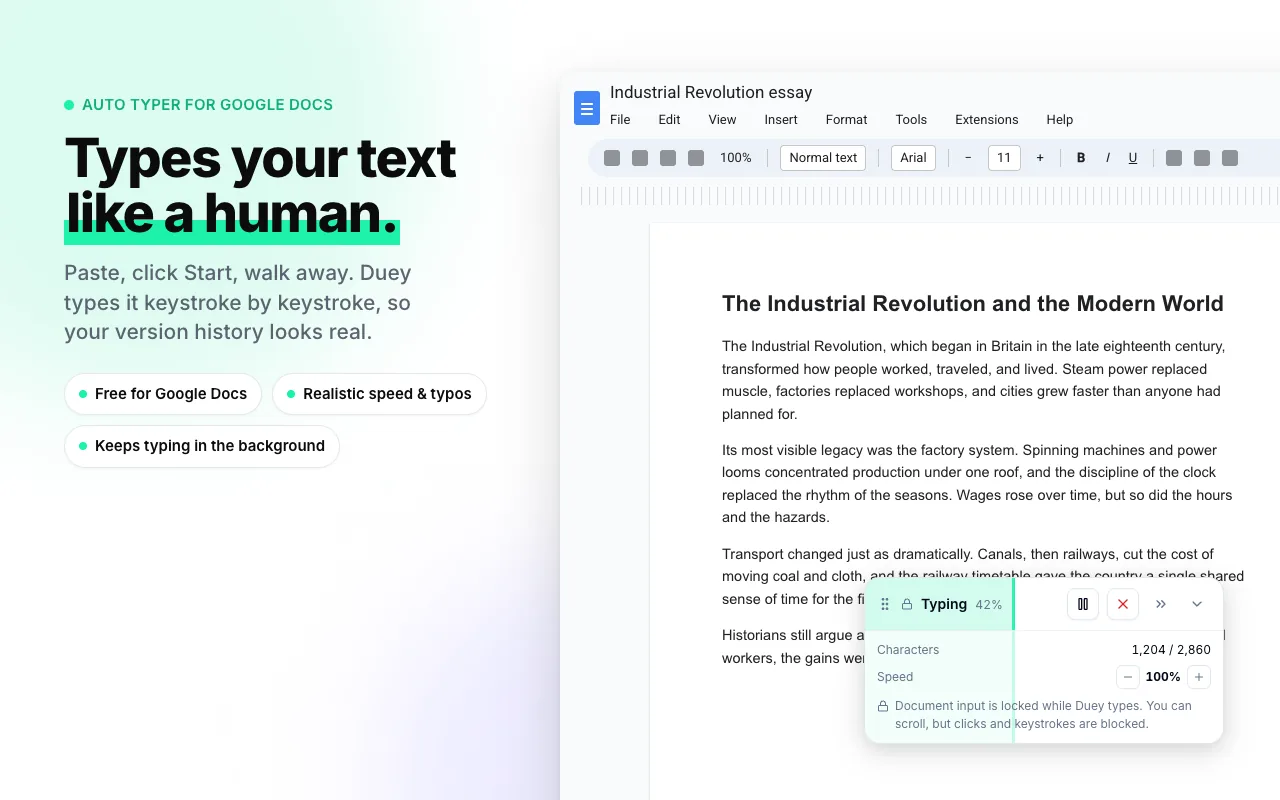
Mind the revision trail. More instructors now ask for a Google Docs share link and scroll the history alongside the AI score. A finished essay pasted in one block looks suspicious regardless of how it scores, as covered in how teachers check Google Docs version history. The free Duey Auto Typer types text into Docs at a human pace instead of pasting it, and Duey Pro bundles Auto Typer Pro, Sessions, the Humanizer and the AI Detector.
The short version
Turnitin lists Claude by name among the models its detector covers, and independent tests show detectors flag raw Claude output reliably. Claude's 2026 watermark is a separate signal that only key holders can read, and it weakens as text is rewritten. Both systems are weakest against mixed, short and heavily revised writing.
FAQ
Is Claude harder to detect than ChatGPT?
Not in any reliable way. Turnitin trains on both model families, and both produce the low-perplexity, low-burstiness text classifiers look for. Differences in tone are visible to readers, not to the score.
Can Turnitin read Claude's watermark?
Turnitin's AI score comes from its own classifier. Anthropic's watermark detection API is in private preview for eligible organizations, and there is no public information about Turnitin using it.
Does editing Claude's text remove the watermark?
According to Anthropic, light editing probably won't remove it completely, while a full rewrite where every word is replaced will. Partial edits weaken the signal in between.
Can I use Claude for brainstorming without getting flagged?
Turnitin scores the submitted text, not the process behind it. Outlines, questions and notes that never appear in the final draft have nothing for the detector to measure. Course policies on AI use vary, so the syllabus is the place to check what is allowed.
Does Claude Opus get detected as often as Haiku or Sonnet?
In GPTZero's July 2026 test, all three were flagged on every sample. Turnitin's documentation lists Sonnet and Opus versions explicitly.
Drafting with Claude? Check your draft with Duey's AI Detector before you submit, then run flagged passages through the Humanizer.