How Turnitin's AI Detection Actually Works
Turnitin's AI score is not a verdict. Here is how the classifier is trained, where it breaks, and what the number means.
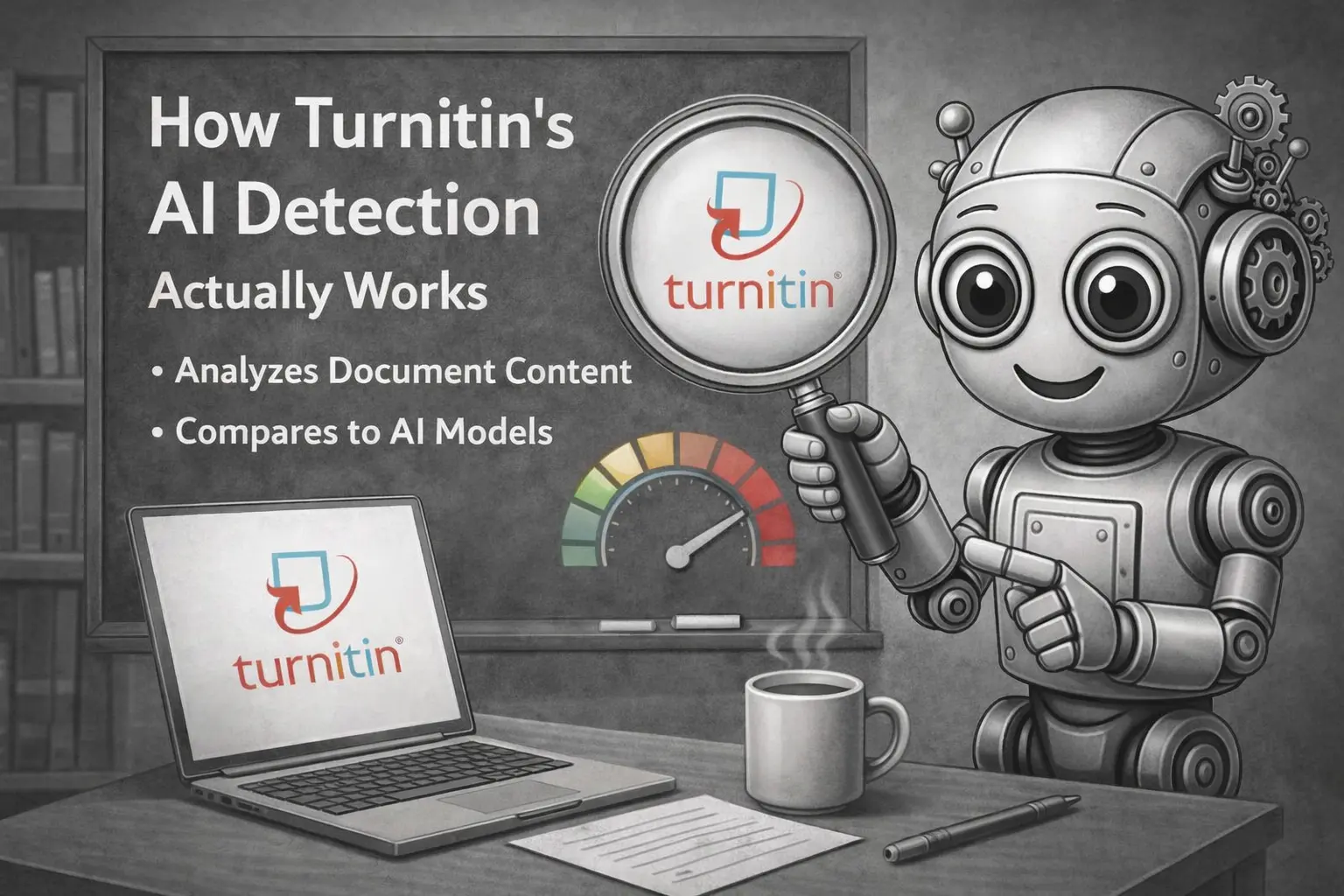
An instructor opens a submission, sees a “94% AI-generated” score from Turnitin, and stares at the number like it has told her something she can act on. It has not. That number is a confidence estimate from a statistical classifier trained on text samples produced by OpenAI and a few academic corpora. It is a probability, not a verdict. Treating it as proof is how false accusations happen.
This is how the tool actually works, where it is reliable, and where it is not.
What Turnitin’s AI score is measuring
Turnitin’s AI writing indicator is a separate system from its plagiarism tool, added to the Originality product in April 2023 and refined several times since. The score it surfaces is the percentage of the document that the classifier believes was generated by a large language model. A document scored at 94% is one where the classifier flagged 94% of qualifying segments as likely AI-written.
The underlying model is a transformer-based classifier trained on a curated dataset of human writing alongside synthetic text from GPT-3, GPT-3.5, and later GPT-4. Turnitin has not published the exact architecture, but it has confirmed the approach in its own AI writing detection documentation and in vendor briefings to universities.
Each document is broken into passages of roughly 200 words. The classifier scores each passage independently, and the overall indicator is the weighted proportion of passages judged likely AI-generated above Turnitin’s confidence threshold. That last piece matters. The tool is conservative by design: it suppresses low-confidence guesses so the visible score understates the raw output of the classifier. Turnitin has stated publicly that it tuned for a document-level false-positive rate below 1%, at the cost of higher false negatives.
Meaning: the tool would rather miss AI than flag a human. Which also means many AI-generated papers score low.
How the score is calculated in practice
Three rules govern what does and does not get scored:
Minimum length. Documents shorter than 300 words are not processed at all. Students submitting short-answer work will see no indicator, regardless of how the work was produced.
Eligible passages. The classifier only scores prose. Lists, code blocks, equations, tables, and quoted material are typically excluded. A paper that is heavy on citation or heavy on list formatting will have fewer scored passages, which changes the denominator of the final percentage.
Language. Turnitin’s AI detector was built for English. Non-English submissions either return no indicator or return an unreliable one. Stanford researchers found in a 2023 study that GPTZero and competing detectors misclassified essays by non-native English speakers as AI-generated at rates exceeding 60% on certain sample sets. Turnitin has acknowledged the pattern and says its tool has been refined against ESL writing, but no independent audit has confirmed that claim at Turnitin’s scale.
When a paper passes all three gates, the output you see is a top-of-document percentage with highlighted passages in the body. Hovering over a highlight reveals the model’s confidence for that specific segment. High-confidence highlights are what matter. Low-confidence yellow highlights are closer to a coin flip.
Where the tool breaks
Five failure modes show up consistently in classroom use.
Short papers score unreliably. A 350-word submission has roughly two scorable passages. One misclassified passage can push the whole document to 50% “AI-generated.” The statistical floor is too thin for short work.
ESL writing gets over-flagged. Non-native English speakers tend to use shorter, more formulaic sentence structures that resemble LLM output on perplexity and burstiness metrics. Turnitin’s classifier inherits this bias from the broader detector ecosystem. The Stanford study is the most-cited source; a follow-up from Common Sense Media found similar patterns in K-12 writing samples.
Lightly edited AI output slips through. Paraphrasing tools, manual rewrites, and even a pass through a different model knock down the confidence score quickly. A paper drafted in ChatGPT and then rewritten for voice by the student often scores under 20%. That is not a flaw Turnitin can easily fix without also increasing false positives on unedited human work.
Mixed documents confuse the indicator. A human-written introduction followed by an AI-generated body section is the hardest case. The overall score gets averaged down by the human prose, and the classifier sometimes misses the transition because it scores passages, not the document as a whole.
Model drift. The classifier was trained on outputs from specific models. GPT-5.1, Claude 4.5, and Gemini 3 produce text with subtly different statistical signatures than GPT-4. Turnitin retrains periodically, but there is always a lag. Output from a model released last quarter is usually under-flagged until the next training cycle.
What Turnitin says instructors should do with the score
Turnitin’s instructor guidance is explicit on one point: the indicator is a starting point for conversation, not evidence of academic misconduct. The recommended workflow is:
- Read the flagged passages, not the summary percentage.
- Compare the writing in those passages to prior work from the same student.
- Request a version history or draft file before escalating.
- Do not use the score as the sole basis for a grade penalty or misconduct report.
Most universities that kept the feature on have layered their own policies over this guidance. A common floor is that an AI indicator alone cannot trigger an investigation. Pennsylvania State, Vanderbilt, and Northwestern all suspended or restricted the feature after internal review, citing false-positive rates they considered too high for adjudication. Vanderbilt’s statement specifically noted that Turnitin’s own published error rate “masked the real experience of instructors on the ground.”
Other institutions kept the indicator available to faculty but removed it from student-visible views, which tends to reduce downstream disputes.
The thirty-second version for students
If a Turnitin AI score lands on work you wrote yourself:
- Export your draft history. Google Docs, Word, and Pages all have revision logs that timestamp changes. That file is the single strongest defense against a false positive.
- Read which passages were flagged. The overall percentage is less informative than the location of the highlights.
- Ask your instructor how the score will be used before assuming the worst. Many institutions cannot act on the indicator alone.
- If you are an ESL student and your writing has been flagged, cite the Stanford study. Turnitin’s own documentation acknowledges the bias.
If the work was AI-assisted and you are worried about the score, understand that Turnitin’s classifier measures the statistical shape of the prose. Editing for rhythm and vocabulary moves the score more than changing individual sentences. That is the mechanic Duey’s humanizer and detector tools are built around.
Where this leaves everyone
Turnitin is doing something real. The classifier is not snake oil. But a percentage generated by a probability model is not proof of authorship, and the tool’s design concedes as much. The institutions that have pulled back from AI detection did so because the downstream cost of a false accusation outweighs the upside of catching a cheater who would probably get caught another way.
For students, the two things that matter are version history and sentence-level rhythm. For instructors, the Turnitin indicator is a prompt to look more carefully, not a ruling.
You can run a paper through Duey’s detector to see what a typical classifier does with it before you submit. The output is similar to Turnitin’s but shows the underlying perplexity and burstiness curves that produce the final number.
FAQ
Does Turnitin share AI scores with students?
By default, no. The indicator is visible only to instructors. Some institutions have opted to surface it to students; others have turned the feature off entirely. Check your school’s policy.
Can Turnitin detect Claude or Gemini output?
Unevenly. Turnitin trained primarily on OpenAI model outputs, and detection accuracy drops for text generated by newer non-OpenAI models. Lightly edited output from any model often scores under the confidence threshold.
What percentage is considered “flagged”?
Turnitin does not publish a cut-off. Anything above 20% typically triggers a review in practice, but institutional policies vary widely. The more important signal is the location and confidence of the individual highlights.
Does Turnitin detect AI-assisted editing, or only AI drafting?
The classifier scores the final prose, not the process. A document lightly edited by a human after being drafted by AI scores lower than a pure AI draft, sometimes dramatically lower. A document drafted by a human and edited by AI for grammar scores roughly like pure human writing.
Is the AI indicator legally defensible?
The score is an input, not a proof. In every academic integrity case where Turnitin scores have been challenged, the institution has had to produce additional evidence — version history, inconsistency with prior work, direct admission — to prevail. The University of Minnesota case is the most-cited example of an institution walking a charge back after the student produced draft files.
Want to see how your writing reads to a real AI classifier before you submit? Try Duey’s AI detector. It exposes the perplexity and burstiness curves behind the percentage so you understand the number instead of guessing at it.