Duey.ai Humanizer & Auto Typer 2.0 with Anti-detection
We're launching our Auto Typer 2.0 to help combat organizations that are surveilling writers. Learn more about Auto Typer Pro.
Your Tools, Your Business
Why we built anti-detection into Duey Auto Typer — and why we'll never apologize for it.
TL;DR
Detection tools are now catching auto-typers. Third-party extensions can now identify typing assistants like Duey and report your usage to employers, schools, or platforms — without your knowledge.
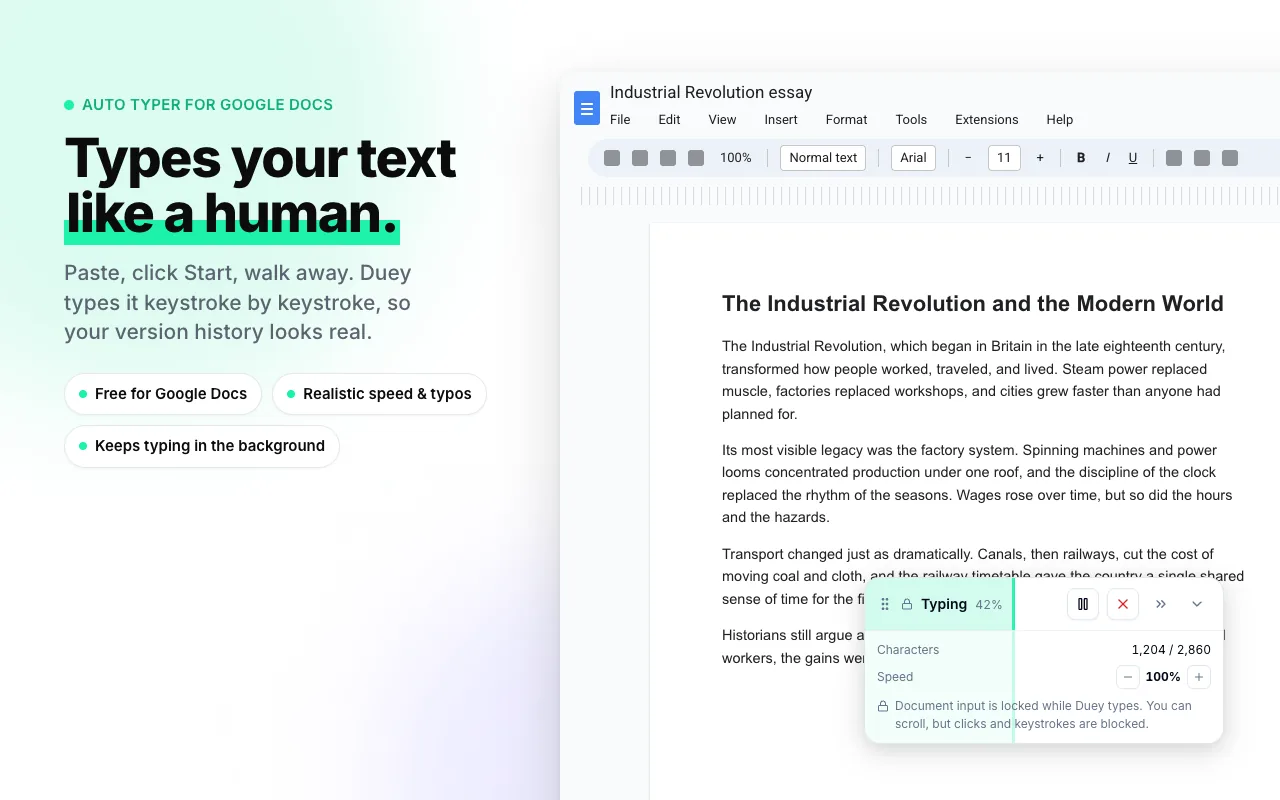
We built something that keeps you safe. Auto Typer Pro simulates natural human typing — adaptive rhythm, realistic pauses, even occasional typos that get corrected — so your sessions look indistinguishable from a real person at the keyboard.
Try it yourself. Pro is $4/month, but every free user gets one Pro session to try — no card required. The free auto typer isn't changing. Try Auto Typer Pro →
Why we did this — and what we believe about surveillance, accessibility, and your right to use the tools that work for you — is below.
The full story.
We hear from our users every day. A mom who works two jobs and uses her bus commute to dictate documents, then needs them typed into Google Docs before her shift starts. A graduate student with dyslexia who knows the material cold but hits a wall when it's time to get 5,000 words onto a page. A software engineer with a repetitive strain injury who can architect a system in his head but can't type for more than ten minutes without pain.
None of these people are cutting corners. They're using a tool that bridges the gap between what they know and what they can get on the page. That tool is Duey Auto Typer, and today we're writing to tell you what's changed, what hasn't, and why.
A lot of people need tools like this. More than you'd think.
There's a persistent idea that typing assistants are novelties — toys for people who don't want to do the work. That hasn't been our experience. Not even close.
Nearly 70 million American adults — about 29% of the adult population — report at least one functional disability (The Global Statistics). The global assistive technology market hit $26 billion in 2025 and is projected to nearly double by 2030 (Market.us). This isn't a niche. It's a massive, underserved population of people who need technology to meet them where they are.
Dyslexia alone affects roughly 1 in 10 people. For many of them, the bottleneck was never knowledge or effort — it's the mechanical act of translating thought into written text (International Dyslexia Association). ADHD, which affects an estimated 4.4% of American adults, creates its own challenges with sustained focus on repetitive tasks. Research from the Yale Center for Dyslexia found that assistive technology is often the critical factor in helping people keep pace with peers as demands increase through school and into their careers (Yale Dyslexia).
And then there are the people who don't have a diagnosis. They have a deadline, three kids, and a document they've already written in their head or dictated into their phone. They just need it in Google Docs with an edit history because that's what their school, employer, or client requires.
We built Duey for all of them. Every single one.
Something changed.
Recently, we became aware that third-party tools have been developed to detect and flag the use of typing assistants like ours. These tools work by reverse-engineering the behavioral patterns of extensions like Duey, then reporting that information back to whoever's asking — an employer, an institution, a platform.
Let's be clear about what that means: someone using Duey to type a document — whether they're doing it because of a disability, a time constraint, or a personal preference — could be flagged and reported without their knowledge or consent.
This isn't happening in a vacuum. Workplace and academic monitoring is a rapidly growing industry. Research shows that 78% of companies now use some form of employee monitoring software, up significantly from just a few years ago (Apploye). The surveillance software market itself is growing at over 14% annually (Fortune Business Insights). The trend is clear: more monitoring, more reporting, less autonomy over your own workflow.
We think that trend deserves pushback.
Why we fought back.
We updated Duey Auto Typer to make it significantly harder for third-party detection tools to identify its use. Not by hiding it — by making it indistinguishable from real typing. We did this deliberately, and we'd do it again.
Here's why.
The Americans with Disabilities Act and Section 508 of the Rehabilitation Act protect people's right to reasonable accommodations, including assistive technology (ADDitude Magazine; EPA — Section 508). But here's the catch: to get those accommodations, people often have to formally disclose their condition. That creates a real privacy dilemma — especially for people with invisible disabilities who'd rather not broadcast their medical history to an employer or institution just to justify using a typing tool (ACM Digital Library).
When surveillance tools normalize the detection and reporting of assistive technology, they create a chilling effect. People who genuinely need these tools become afraid to use them. That's not a hypothetical. We've heard from users who stopped using Duey — not because it wasn't helping them, but because they were afraid of being flagged. That's unacceptable.
Now, let's talk about the elephant in the room.
We know that not every Duey user has a disability or a documented need. Some people use it because it saves time. Some people use it because they'd rather spend an evening with their family than retyping a document they already wrote. Some people use it for reasons they haven't shared with us, and that's fine — they don't owe us an explanation.
We don't judge. We built a tool. How you use it is between you and your conscience — not between you and a surveillance extension.
What's changing (and what isn't).
We want to be completely transparent about what this update means for you.
What's staying free — now and always:
The core Duey Auto Typer extension works exactly the way it always has. No features removed, no paywalls on existing functionality. If you sign in for the authenticated experience, you'll still get additional settings at no cost. The free tier is not going away. Period.
What's new — Auto Typer Pro ($4/month):
Pro doesn't just type your text — it types like you would. Standard auto-typers produce output at a fixed, robotic speed. Detection tools look for exactly that kind of pattern. Pro mode eliminates it entirely by simulating how a real person actually types:
- Adaptive typing rhythm — Speed fluctuates naturally instead of staying constant. Because no one types at exactly 62 WPM for forty-five minutes straight.
- Context-aware pacing — Pro pauses at paragraph breaks and sentence boundaries, the way a real person stops to think before moving on.
- Realistic error correction — Occasional typos with natural backspace-and-fix behavior, capped at a low rate to stay believable. Because real humans make mistakes and catch them.
- Configurable WPM — Set your target speed and Pro builds a realistic session around it.
- Pre-computed sessions — Your entire typing session is planned before it starts, so execution is smooth and uninterruptible. No lag, no hiccups.
Pro mode is available as a one-click upgrade from the standard auto typer. Every free user gets one Pro session to try it out — no card required.
The bundle ($5/month):
If you use our other tools, the full Duey suite is available for $5-9.99/month, which includes Pro typing and everything else we offer.
Why does this cost money?
We'll be honest: the level of realism in Pro mode isn't trivial to build. Every typing session is individually computed to look natural, and as detection methods evolve, our simulation has to evolve with them. That requires ongoing engineering and infrastructure that costs real money to maintain. We chose to make it an optional upgrade rather than raising prices across the board or compromising the free experience.
Who we are.
We built Duey because we believe people deserve tools that meet them where they are — not where someone else thinks they should be.
We're not anti-institution. We understand that schools and employers have legitimate interests. But we also believe that the tools you use to get your work done are your business, and that the growing ecosystem of surveillance software is solving a problem most people don't actually have, at the expense of people who are just trying to get through their day.
If the free version is all you need, it's yours. Forever.
If you need Pro, we built it for you.
Either way — we're glad you're here.